Views: 0 Author: Site Editor Publish Time: 2026-05-15 Origin: Site
Architects, developers, and facade engineers face a high-stakes reality daily. Selecting the wrong cladding can trigger severe fire compliance failures. It can also cause premature panel delamination or cascading project delays. You need materials offering absolute reliability under intense environmental pressure. Both solid panels and composite options dominate the commercial cladding market today. However, modern building codes and strict lifecycle priorities continuously shift the core evaluation criteria. Decision-makers can no longer rely on outdated assumptions to specify building envelopes. Every structural choice carries immense liability. This article provides an evidence-based, side-by-side technical comparison of these leading options. We aim to help specifiers finalize their facade material selection confidently. You will learn to navigate structural, aesthetic, and compliance realities. You can make an informed choice without falling for manufacturer hyperbole.
Fire Safety: Solid aluminum veneer inherently achieves top-tier non-combustible ratings (Class A1), whereas ACP requires specific, often more expensive, fire-rated (FR) mineral cores to meet modern compliance.
Cost vs. Longevity: ACP offers lower initial procurement and installation costs, but aluminum veneer provides superior long-term durability and higher salvage value.
Design Constraints: Aluminum veneer excels in complex, 3D, and curved geometries, while ACP is unmatched for large, perfectly flat, lightweight expanses.
Risk Profile: ACP carries a long-term risk of core delamination under severe weather cycling; solid aluminum is immune to delamination but susceptible to minor surface "oil-canning" if not engineered correctly.
Specifiers must understand the fundamental physical differences between these materials before evaluating their performance. The inherent structural composition dictates everything from fabrication limits to extreme weather resistance.
Solid aluminum veneer uses a single monolithic layer of metal. Thickness usually ranges from 2.5mm to 3.0mm for exterior applications. Manufacturers overwhelmingly prefer 3000 series (like AA3003-H14) or 5000 series (like AA5005-H14) architectural alloys. These specific alloys offer excellent tensile strength and superior corrosion resistance.
Factories use advanced CNC machines to cut these thick sheets precisely. Technicians then bend, form, and weld the units into rigid architectural elements. Workers polish the welded corners to create a seamless aesthetic. Finally, they apply a durable PVDF (polyvinylidene fluoride) or powder coating finish. The end result is a unified, highly robust element. There are no secondary layers or hidden cores. The panel acts as one cohesive structural body.
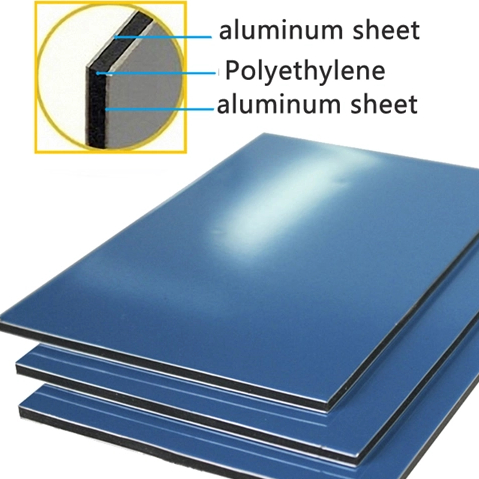
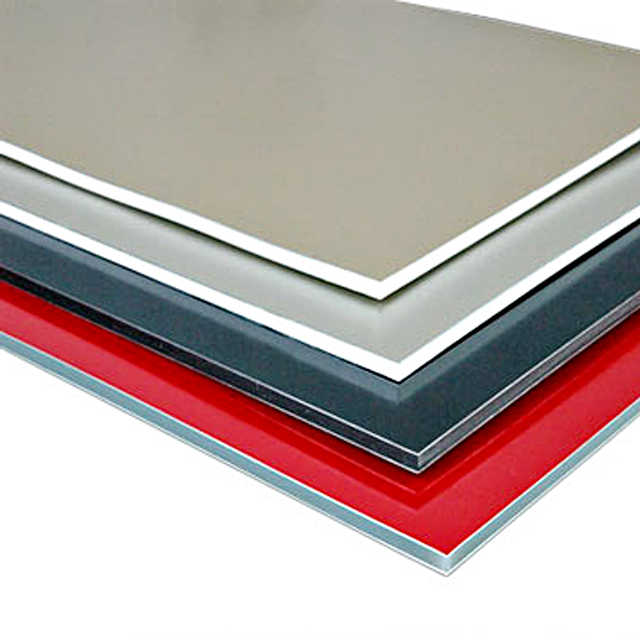
Aluminum Composite Panels utilize a vastly different structural approach. They feature an engineered composite "sandwich" design. Factories bond two very thin metal skins to a central core material. Skin thickness typically measures between 0.3mm and 0.5mm. Advanced continuous lamination lines apply immense heat and pressure to permanently fuse these distinct layers together.
The core material dictates the panel's overall safety and behavioral performance. Older legacy panels used combustible polyethylene (PE) cores. Modern iterations utilize advanced fire-retardant (FR) mineral cores to improve high-rise safety. The composite nature gives ACP its defining characteristics: extremely low weight and exceptional surface flatness.
Material Characteristic | Solid Veneer | Composite Panel (ACP) |
|---|---|---|
Overall Composition | Single monolithic alloy layer | Two thin skins bonded to a core |
Standard Exterior Thickness | 2.5mm to 3.0mm | 4.0mm to 6.0mm (total sandwich) |
Primary Core Material | None (100% Solid Metal) | PE (Polyethylene) or FR (Mineral) |
Fabrication Methodology | CNC cut, welded, post-painted | Pre-painted coils, continuous lamination |
Engineers evaluate cladding based on strict performance dimensions. Modern building envelopes must withstand intense environmental forces. They must also meet increasingly stringent global safety mandates. You cannot compromise on these core evaluation metrics.
Fire safety represents the most critical metric in modern facade design. Solid metal stands as a 100% non-combustible material. It naturally achieves Class A1 fire ratings under European EN 13501-1 standards. It easily passes rigorous tests like the NFPA 285 standard. This inherently eliminates fire-spread risks in high-rise applications. Specifiers frequently mandate solid monolithic panels for critical infrastructure, hospitals, and towering skyscrapers. They leave no room for ambiguity regarding combustibility.
ACP performance depends entirely on its hidden core. Standard PE-core ACP burns rapidly and contributes to facade fire spread. Jurisdictions globally now aggressively ban PE-cores in high-rises. FR-core ACP can meet strict building codes and achieve Class B or Class A2 ratings. However, specifying them requires rigorous local compliance auditing. Building inspectors demand extensive certification paperwork for composite materials. You must prove the specific panel lot meets local fire code mandates.
Engineers must balance building dead loads against structural stability. ACP offers an exceptionally lightweight profile. A standard 4mm composite panel weighs significantly less than a 3mm solid sheet. This drastically reduces structural dead loads on the building frame. It allows engineers to design lighter, more efficient substructures.
Conversely, solid metal panels weigh considerably more. They require a far more robust framing system. Installers must use heavier, specialized anchors. However, this added mass provides distinct advantages. Solid panels offer higher sheer strength. They manage extreme wind loads on supertall structures exceptionally well. Engineers can confidently design systems meeting strict L/175 deflection limits. The robust nature of solid metal prevents excessive bowing during violent coastal storms.
Performance Metric | Solid Monolithic Panels | Composite Panels (ACP) |
|---|---|---|
Combustibility Rating | Non-Combustible (Class A1) | Combustible to Fire-Retardant (Core Dependent) |
Wind Load Deflection Resistance | Extremely High | Moderate to High |
Substructure Load Burden | Heavy | Very Light |
Architects demand immense visual freedom when designing landmark structures. Both materials offer distinct aesthetic capabilities. You must align your geometric vision with the correct material properties.
Architects increasingly incorporate parametric designs into modern facades. Solid monolithic panels deliver unmatched versatility here. Fabricators can weld, roll, and perforate them into intricate 3D shapes. They utilize 5-axis CNC machines to achieve dramatic curves. These aggressive fabrication processes never expose vulnerable internal edges. You can achieve tight corners, custom returns, and dramatic geometric folds seamlessly.
ACP maintains superior panel flatness across extremely large dimensions. It effectively minimizes the "oil-canning" waviness commonly seen in large sheet metal expanses. The rigid sandwich structure keeps the visual face perfectly taut. However, composite panels struggle with tight radii. You cannot execute complex geometric folds easily. Extreme bending cracks the thin exterior skin. It also exposes the inner core to environmental degradation.
Both cladding types utilize premium PVDF coatings. Manufacturers apply resins containing 70% fluoropolymer (like Kynar 500). These coatings provide exceptional UV resistance. They prevent fading, chalking, and chemical damage over decades of sun exposure. Both materials meet strict AAMA 2605 weathering specifications.
Solid panels hold a distinct, critical advantage in edge-weathering. The monolithic design leaves no susceptible internal layers exposed. Fabrication happens before the final coating process. The paint covers every cut edge and welded seam perfectly. ACP edges present a different challenge entirely. Installers must seal every exposed composite edge meticulously. Moisture ingress quickly leads to severe core degradation. Over time, poorly sealed composite edges will trap water, freeze, delaminate, and ultimately fail.
Theoretical performance means little if contractors cannot install the material effectively. Site realities dictate strict handling procedures. Specifiers must account for thermal expansion, site tolerances, and jointing methodologies.
Contractors value materials adapting to unpredictable site conditions. ACP excels in this specific area. Installers can route, groove, and fold composite panels directly on the job site. This flexibility allows for immediate, last-minute dimensional adjustments. If the concrete framing is slightly misaligned, workers adjust the composite panel instantly.
Solid metal units require a far more rigid approach. Factories prefabricate them precisely according to approved shop drawings. On-site modifications prove highly difficult and heavily discouraged. Cutting or grinding solid metal on-site risks severe damage. It compromises the factory-applied protective finish. Exposed bare metal quickly leads to localized galvanic corrosion. You must ensure perfect field measurements before fabrication begins.
Facade engineers must carefully calculate thermal expansion metrics. Aluminum expands significantly under solar heat gain. Solid metals expand and contract at different rates than composite sandwiches. This physical reality dictates specific jointing methodologies.
ACP relies heavily on continuous structural silicones. Installers must apply wet sealants meticulously to protect the hidden core from moisture. These sealants require replacement every 10 to 15 years. Solid elements easily accommodate sophisticated open-joint rainscreen designs. These systems manage water ingress through clever cavity ventilation and baffled joints. Open rainscreens eliminate the long-term reliance on degrading chemical sealants. They allow the building envelope to breathe effectively.
A successful installation requires strict adherence to technical steps. Contractors should follow this standard methodology:
Conduct precise laser-scanning of the as-built substructure to capture structural deviations.
Engineer robust shop drawings to dictate exact panel dimensions and bracket locations.
Install thermal isolators between the cladding brackets and the main concrete structure.
Secure the panels using engineered extrusions and floating anchor points to allow thermal movement.
Verify proper cavity ventilation spacing for open-joint rainscreen configurations.
Evaluating solid panels against composite options for your next curtain wall panel requires a systematic approach. Specifiers should never rely on isolated metrics. You must match material behaviors directly to distinct project realities.
Composite panels suit specific architectural scenarios perfectly. They provide immense value when deployed in the correct context. Consider shortlisting them under the following parameters:
Project Scale: Ideal for low-to-mid-rise commercial buildings where extreme wind loads are minimal.
Application Scope: Excellent for interior cladding, corporate signage, retail storefronts, and large canopy fascias.
Geometry: Best suited for projects requiring standard, flat geometric expanses without compound curves.
Critical Condition: You must ensure rigorous, independent verification of FR-core certification for any exterior facade use.
Solid panels provide uncompromising performance for critical envelopes. They eliminate structural risks associated with composite delamination. They become mandatory under these strict conditions:
Fire Safety: Essential for supertall high-rise facades demanding absolute, zero-risk fire compliance.
Architectural Expression: Best for monumental buildings requiring complex, multi-dimensional shapes or perforated screens.
Durability: Required for public transport hubs, airports, or museums needing multi-decade lifespans in harsh environments.
Design Intent: Ideal when architects specify advanced open-joint, unsealed rainscreen systems.
The architectural material debate is never about establishing universal superiority. It focuses entirely on matching specific material behaviors to unique project realities. Solid metal panels offer unmatched fire safety, geometric flexibility, and rugged durability. They act as impenetrable armor for high-rise structures. Conversely, composite panels deliver exceptional flatness, lightweight properties, and rapid site adaptability. They excel in applications prioritizing vast, flat visual expanses.
Specifiers must prioritize life safety and structural physics above all else. Evaluating local fire codes, structural weight limits, and site weather conditions must precede purely aesthetic considerations. We strongly recommend consulting a specialized facade engineer early in the conceptual design phase. They can conduct a thorough, project-specific performance analysis. Careful planning prevents catastrophic failures and ensures long-term envelope integrity. If you are struggling to finalize the ACP vs aluminum veneer debate for your specific project, reach out to our technical team for specialized structural support.
A: The legality depends strictly on the core material and local jurisdiction. PE-core panels are widely banned globally for high-rise applications due to extreme fire risks. However, FR (fire-retardant) or A2-core composite panels are often permitted. You must verify local building codes and secure proper certification before specifying them.
A: Yes, it is 100% recyclable. Solid panels require no complex separation processes at the end of their lifecycle. Facilities simply melt the monolithic metal down for immediate reuse. Composite panels, conversely, require difficult and energy-intensive core-separation procedures before recycling.
A: Composite panels generally provide superior acoustic performance. The multi-layered sandwich design inherently dampens vibration and sound transmission much better than a single sheet of solid metal. The central core absorbs external noise effectively.
A: Preventing oil-canning requires careful engineering. You should increase the overall panel thickness for large spans. Engineers must utilize concealed stiffener ribs welded to the panel's backside. Furthermore, installers must ensure proper tension and allow for thermal movement during installation.