Views: 0 Author: Site Editor Publish Time: 2026-10-11 Origin: Site
Moisture often spells disaster for commercial building facades. When water penetrates a building envelope, it causes severe structural damage. You might face substrate rot, degraded insulation, or hazardous mold growth. These failures halt operations and force massive repair bills.
Many project managers and architects wonder about panel durability. They frequently ask if is acp sheet waterproof at a fundamental level. Technically, the material itself repels water perfectly. However, a building facade is only as waterproof as its installation system, joint sealing, and drainage architecture. Poor detailing causes leaks, not bad panels.
This guide breaks down the engineering behind keeping commercial facades dry. We will compare installation systems and outline critical detailing requirements. You will learn how to prevent joint failure and manage inevitable moisture through proper drainage design.
Material vs. System: Aluminum composite panels are inherently impermeable to water, but the overall facade system requires precise engineering to prevent leaks.
The Sealant Vulnerability: 90% of moisture issues stem from improper aluminum composite panel joint sealing, not the panels themselves.
Drainage is Mandatory: A fully sealed facade is a myth. Effective systems utilize "rain-screen" principles with dedicated drainage and ventilation to manage inevitable moisture penetration.
Thermal Movement: Waterproofing strategies must accommodate the natural thermal expansion and contraction of aluminum to prevent seal rupture.
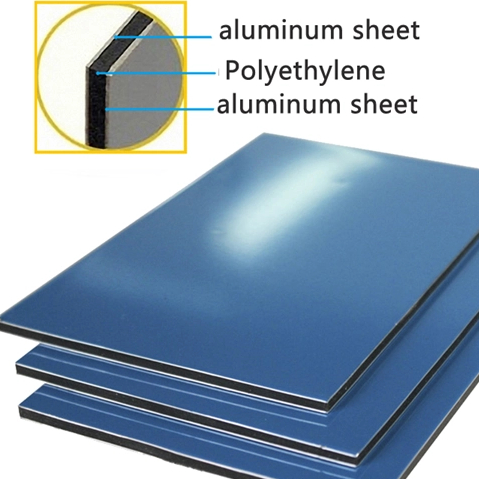
Before examining facade systems, we must understand the core material. Manufacturers bond two thin aluminum skins to a central core. This core usually consists of polyethylene (PE) or fire-retardant (FR) minerals. Neither the aluminum nor the core materials absorb water. The flat surfaces of the panel remain highly impermeable. Therefore, baseline aluminum composite panel water resistance is excellent.
However, vulnerabilities exist at the panel edges. Installers cut these panels to fit specific building dimensions. Cutting exposes the inner core and the adhesive bond lines. If these exposed edges sit in standing water, capillary action can draw moisture inward. Over time, freeze-thaw cycles expand this trapped moisture. This expansion leads to edge delamination. Panels warp, and the structural integrity degrades.
We must shift our focus from material properties to system engineering. Buyers often ask the wrong questions. You shouldn't ask if the panel itself resists water. Instead, ask how the entire panel system keeps the building dry. Engineering a waterproof facade requires managing joints, controlling water flow, and protecting exposed edges from constant saturation.
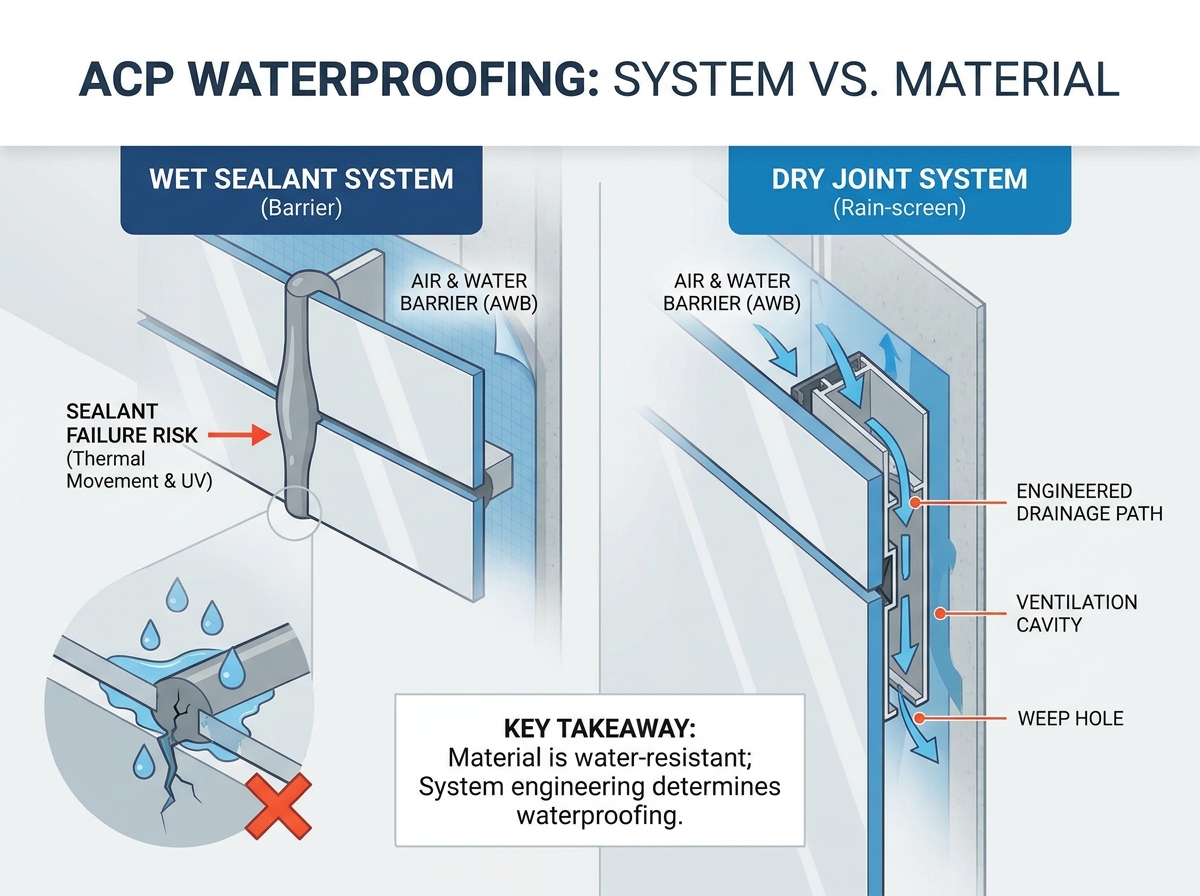
Choosing the right acp cladding installation method dictates the long-term weatherability of your facade. Contractors generally use two distinct approaches: wet sealant systems and dry joint systems. Each method treats moisture management differently.
In a wet system, installers place panels side-by-side on the sub-frame. They fill the remaining gaps entirely with silicone sealant. This creates a primary, continuous barrier against the elements. It attempts to seal the building tight.
Pros: Wet systems carry a lower initial upfront cost. The installation process is simpler and requires less complex metal fabrication. It works well for straightforward geometric designs.
Cons/Risks: This method relies 100% on installer precision. A single missed gap or air bubble creates a leak point. Silicone sealants suffer from UV degradation over time. Thermal expansion stretches and compresses the joints daily. Dirt streaking is also very common as dust adheres to the silicone.
Dry systems abandon the idea of a perfect exterior seal. Instead, they use specialized aluminum extrusions and rubber gaskets. The system acknowledges some water will enter the joints. Engineers design hidden channels to drain this water back outside safely.
Pros: Dry systems offer superior long-term reliability. They provide better pressure equalization, stopping wind from driving rain into the building. They require zero reliance on exterior caulk joints, eliminating messy dirt streaks.
Cons/Risks: This approach requires much higher engineering expertise. Fabricating the specific extrusions and routing the panels increases the upfront material costs.
Wet vs. Dry Installation Comparison
Feature | Wet Sealant System | Dry Joint System |
|---|---|---|
Primary Defense | Exterior silicone caulk | Pressure equalization & drainage channels |
Maintenance | High (re-caulking every 10-15 years) | Low (gaskets degrade much slower) |
Aesthetic Risks | Dirt streaking, uneven sealant lines | Clean, sharp mechanical joints |
Best Application | Low-rise buildings, budget projects | High-rises, severe weather zones |
Use a clear decision framework. We recommend dry systems for high-rises or extreme weather environments. Wind loads push traditional wet seals to their breaking point at higher elevations. Choose wet systems only for low-rise, budget-conscious applications where routine maintenance remains easily accessible.
If you choose a barrier method, aluminum composite panel joint sealing becomes your most critical defense line. Most failures occur right at these intersections. Poor sealing practices guarantee future water damage.
Never apply silicone directly into an empty joint space. Installers must insert a foam backer rod first. A backer rod prevents three-sided adhesion. If sealant sticks to the left panel, the right panel, and the back substrate, it cannot stretch. When panels move, the restricted sealant tears. A backer rod ensures the silicone only adheres to the two opposing panel edges. This allows the sealant to stretch and compress like a rubber band.
Contractors must use high-movement, weather-grade architectural silicone. Neutral cure silicone is mandatory. Cheap commercial caulks or acetoxy silicones degrade quickly under UV light. They also release acids during curing, which damages the panel's paint finish. Always verify the sealant manufacturer's compatibility data for aluminum composites.
Aluminum moves significantly when temperatures change. Expanding panels push against each other. If joint widths are too narrow, the expanding panels will compress the sealant until it bulges out. When panels contract in the cold, they pull the joint apart. If contractors do not calculate joint widths based on local temperature extremes, thermal movement will tear the sealant. This instantly destroys the waterproofing layer and causes panel bowing.
Even premium sealants fail on dirty surfaces. Installers must prep the panel edges meticulously. They need to clean away fabrication dust, protective film residue, and atmospheric dirt. Applying an approved primer to the aluminum edges ensures maximum chemical adhesion. Skipping this step leads to silent, invisible adhesive failures.
Experienced architects know that a perfectly sealed building is an illusion. Water will eventually breach outer seals. Wind-driven rain and capillary action easily force moisture through microscopic cracks. Proper acp facade drainage details embrace this reality.
A resilient facade uses multiple layers of defense. The outer cladding handles UV rays, wind, and bulk water. The inner layers manage the residual moisture. We call this defense-in-depth. It ensures a single point of failure does not compromise the interior walls.
Horizontal extrusions in dry systems catch water. Weep holes sit at the base of these extrusions to channel water back out. However, open holes create a vulnerability. Upward wind pressure can easily drive rain backward into these exact same weep holes. Engineers solve this by installing baffles. Baffles act as one-way valves. They let water drain out but block wind from pushing water inside.
The panels themselves act as a rain-screen, but the actual waterproofing happens at the building substrate. Contractors apply continuous Air and Water Barriers (AWB) directly over the exterior sheathing. This commercial weather barrier sits safely behind the cladding. If water bypasses the panels, it hits the AWB and flows downward to the flashings. The AWB protects the structural studs and insulation.
Moisture management also requires airflow. Facades need a continuous air gap behind the panels. This cavity allows air to circulate. When condensation forms behind the metal panels overnight, the circulating air dries it out during the day. Trapped, stagnant air leads to prolonged moisture exposure and eventual corrosion of the sub-framing.
You need competent partners to execute complex acp waterproofing strategies. Vetting contractors protects your investment. Look beyond basic pricing and examine their engineering methodology.
Never accept generic installation guidelines. Advise your buyers to demand project-specific shop drawings. These drawings must detail the most vulnerable areas. Check how they plan to seal joint intersections. Scrutinize the window head and sill flashings. Ensure parapet caps direct water away from the facade face, not into it.
Theories often fail in the field. Require a visual mock-up before full project rollout. Once built, mandate an AAMA 501.2 water hose test. This standard test uses a calibrated nozzle to blast water at the joints. It quickly reveals unsealed intersections and failing gaskets. Fix these errors on the mock-up, not on the finished tower.
Read the fine print on manufacturer warranties. Many panel suppliers offer 20-year guarantees. However, these warranties usually only cover panel paint fading or core delamination. They explicitly exclude water ingress caused by installation faults. Ensure your contractor provides a separate, robust workmanship warranty for the weatherproofing system itself.
Use this 3-point checklist when interviewing ACP contractors during the bidding phase:
Ask them to explain their preferred method for pressure equalization in dry systems.
Request their calculation sheet showing expected thermal movement for your specific panel dimensions and climate.
Demand a list of the exact AWB membranes and structural silicones they intend to use, including compatibility reports.
While aluminum composite materials resist moisture inherently, calling a facade fully waterproof requires a systemic approach. "Waterproof cladding" is an engineered verb, not an inherent noun. It demands precise joint calculations, quality materials, and rigorous installation oversight.
Project decision-makers must invest heavily in the unseen elements. Focus your budget on robust sub-framing, intelligent drainage design, and high-quality sealants. By prioritizing pressure-equalized rain-screens and continuous weather barriers, you protect the underlying building asset from catastrophic moisture failure.
A: Yes, their water resistance makes them suitable for shower surrounds or wet rooms, provided the joints are appropriately sealed with sanitary silicone.
A: High-quality architectural silicone typically lasts 10–15 years, but this drops significantly if installed without backer rods or if subjected to extreme thermal movement.
A: Yes, but a pressure-equalized rain-screen installation method is strongly recommended over a standard wet-seal method to manage the high volume of water ingress safely.