
Views: 0 Author: Site Editor Publish Time: 2026-10-20 Origin: Site
Copper facades offer unmatched architectural appeal. Their natural patina and extreme longevity captivate designers worldwide. However, modern engineering demands often clash violently against traditional materials. You must address strict weight limits, large-format panel trends, and tight commercial budget constraints. Architects and facade engineers constantly balance aesthetic intent against harsh structural realities. Specifying the wrong metal system often leads to devastating project results. We frequently observe visible oil-canning, massive budget overruns, or critical fire compliance failures on prominent job sites. This guide provides an objective, decision-stage framework. We comprehensively compare the structural, aesthetic, and financial realities of both popular options. Understanding the copper composite panel vs solid copper sheet debate heavily impacts your specific facade design. Our detailed analysis helps specifiers make clear, evidence-based cladding selections.
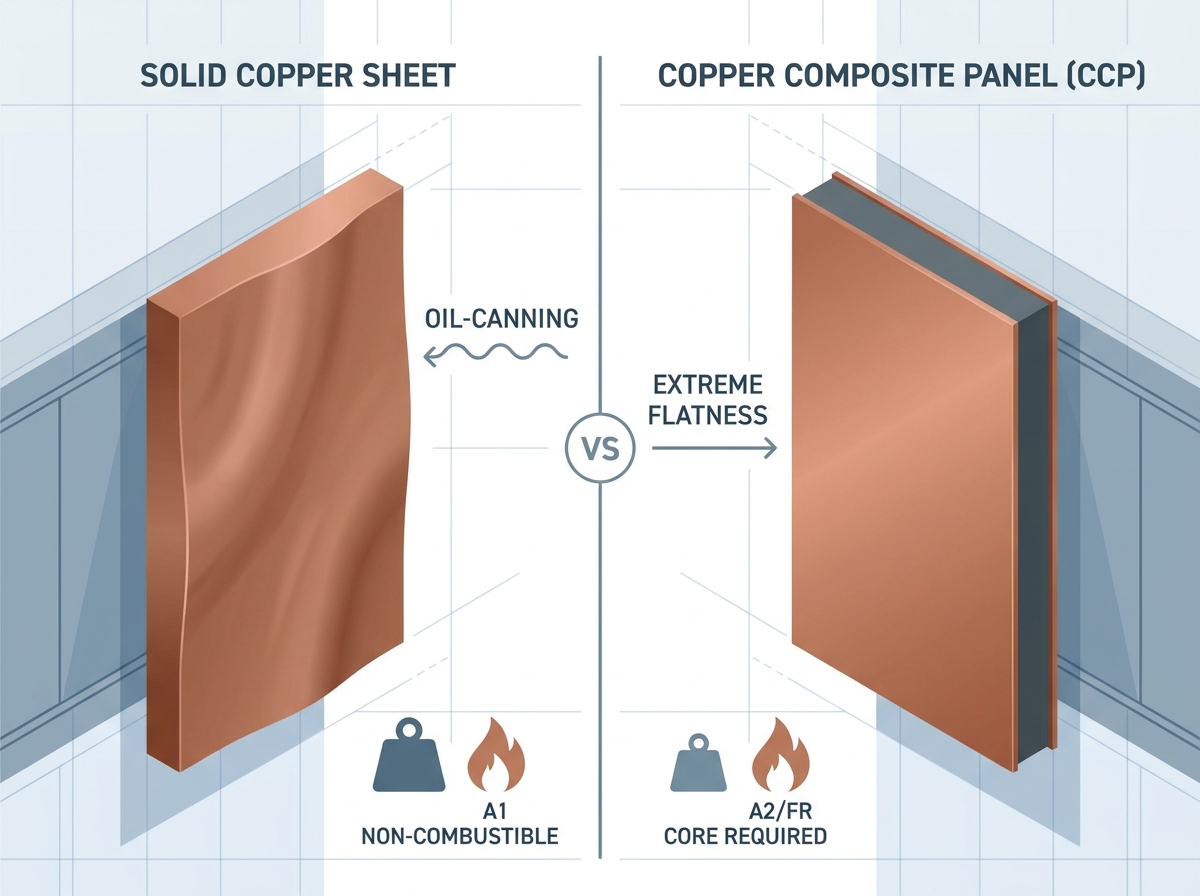
Aesthetics & Flatness: Solid copper is prone to "oil-canning" (visible waviness) on large spans unless specified at a high gauge; copper composite panels (CCPs) deliver extreme flatness due to their rigid core.
Weight & Load: CCPs significantly reduce dead load on the building envelope, allowing for larger panel modules and faster installation compared to heavy solid copper cladding sheets.
Fire & Compliance: Solid copper is inherently non-combustible. CCPs require specialized mineral-filled (FR) or A2-rated cores to meet stringent facade fire codes.
Cost Dynamics: While solid copper is heavily tied to fluctuating global metal commodity prices, CCPs offer more predictable pricing but require specialized fabrication and routing.
You must understand the core composition of each material before specifying them for a high-value facade. They behave completely differently under thermal stress. They also require vastly different fabrication techniques. Let us break down their basic structural definitions to clarify the engineering approach.
A solid copper cladding sheet consists entirely of pure or alloyed copper. Most structural applications rely on specific CDA (Copper Development Association) designated alloys. These monolithic metals offer incredible durability and elemental resistance. They provide uniform material characteristics throughout their entire depth. Historical buildings globally prove their legendary longevity. Many solid copper roofs and architectural facades easily exceed 100 years of active service. Traditional fabrication strongly defines this material category. Artisans typically shape the raw metal using hand-seaming tools and classic brake-forming techniques. It bends easily but requires substantial craft mastery for perfect execution.
A copper composite panel relies on a highly engineered sandwich structure rather than sheer metal mass. It completely reinvents how we apply architectural metals. Manufacturers bind two thin skins of natural copper to a dense internal core. Facade applications typically require a specialized fire-retardant (FR) mineral core. This engineered construction prioritizes extreme structural rigidity. Factories produce them via continuous lamination processes.
A typical architectural composite panel features several distinct layers:
Exterior Skin: A 0.3mm to 0.5mm genuine natural copper sheet exposed to the elements.
Adhesive Film: A high-strength structural polymer binding agent resisting delamination.
Structural Core: A dense, fire-retardant (FR) or A2-rated mineral compound.
Rear Backer: Often a lower-grade copper or aluminum sheet designed to balance internal thermal tension.
Architects often choose copper purely for its dramatic visual impact. You want your facade to look strikingly crisp upon initial installation and deeply beautiful decades later. However, achieving aesthetic perfection on a massive commercial scale requires mitigating physical deflection.
Thermal expansion drastically affects monolithic metals. The sun heats your exterior facade daily, forcing the metal to expand. A solid copper sheet expands and contracts rapidly. Because contractors fix the panel edges firmly in place, the expanding metal must displace somewhere. It inevitably bows outward, creating visible, rippling surface waviness. We call this frustrating phenomenon "oil-canning." It invariably appears on large flat facades unless you specify exceptionally thick, heavy gauges of solid metal.
A composite sandwich structure resists this thermal deflection brilliantly. The dense mineral core stabilizes the thin copper skins continuously across the entire panel face. It absorbs subtle thermal movement internally. The exterior surface remains dead flat across massive architectural spans. Composite panels represent the vastly superior choice for sheer, modern geometric facades. You achieve crisp, highly engineered shadow lines without distracting waviness.
Many specifiers harbor a stubborn misconception regarding composite metals. They falsely assume composite panels utilize fake, printed copper patterns. We must definitively clarify this point. Genuine CCPs utilize real, organically active copper skins. Therefore, they oxidize naturally upon atmospheric exposure. They develop the exact same green or brown patina over time as traditional solid copper. The environmental chemical reaction remains completely authentic.
You must carefully differentiate these genuine products from low-cost faux alternatives. Some manufacturers sell painted aluminum composites designed to mimic metal. We often call these copper finish wall panels. Faux painted panels remain statically colored forever. They never develop a living, evolving patina. If your design vision requires natural atmospheric aging, ensure you explicitly specify genuine copper composites rather than coated aluminum.
Your structural backing wall dictates your cladding choices heavily. Heavy facade materials naturally require robust, highly expensive sub-frames. The installation logic also shifts dramatically between traditional hand-worked metals and modern composite cassette systems.
Compare the actual weight per square meter carefully. Minimizing oil-canning in solid copper necessitates a very thick gauge. A thick monolithic sheet becomes exceptionally heavy very quickly. This extra weight heavily increases the structural requirements of your entire building envelope. Your structural engineers must accommodate these significantly higher dead loads into the foundational calculations.
Conversely, a composite panel achieves immense rigidity at a sheer fraction of the total weight. The mineral core provides substantial volume and stiffness without adding massive tonnage. This lightweight physical property enables tremendous design scalability. Architects can confidently design much larger continuous panel grids. You can span significantly greater distances between attachment points safely.
Cladding Weight and Scalability Comparison Matrix
Performance Metric | Solid Copper Sheet | Copper Composite Panel |
|---|---|---|
Weight Profile | Extremely heavy at gauges required to stop waviness. | Exceptionally lightweight, despite high bending stiffness. |
Dead Load on Envelope | High structural impact requiring reinforced backing. | Minimal structural impact allowing lighter framing. |
Max Flat Panel Size | Small sections requiring frequent expansion seams. | Large spans supporting massive continuous cassettes. |
Oil-Canning Risk | Extremely high without upgrading to thick gauges. | Virtually eliminated by the rigid mineral core. |
Solid copper strictly necessitates highly specialized labor. You must hire traditional roofing experts and sheet metal artisans. They utilize standing seam frameworks or classic flat lock panel techniques. These manual methods require extensive onsite customization. Field conditions, weather, and the individual artisan's skill level dictate the final fabrication quality.
By contrast, modern copper composite wall cladding integrates seamlessly into standard commercial building practices. Facade engineers deploy standardized extruded aluminum rainscreen grids.
We observe a highly streamlined execution process for modern composites:
Contractors survey the primary wall and install the extruded aluminum sub-framing.
Fabricators route and fold the composite panels in a strictly controlled CNC factory environment.
Logistics teams transport the perfectly square, finished cassettes securely to the job site.
Installation crews snap and lock the cassettes directly into the structural grid rapidly.
Standard facade contractors handle this entire process efficiently. You eliminate the need for niche artisan sourcing.
Financial planning for custom metallic facades often involves massive commercial uncertainty. Commodity metal prices fluctuate wildly based on global markets. You must analyze both initial capital outlay and long-term project viability.
Pure solid copper pricing ties directly to the London Metal Exchange (LME). The LME experiences daily, sometimes severe, volatility. This dynamic creates extreme procurement risk during long construction lead times. A commercial project budgeted safely in January might face massive material cost spikes by August.
A copper composite panel isolates your budget from extreme raw volatility. It uses significantly less raw copper per square meter. The stable mineral core and aluminum backer dilute the overall product cost fluctuations. However, composites do carry higher initial manufacturing costs. Continuous lamination lines and precision CNC routing require massive, expensive factory equipment.
Labor heavily dictates final installed facade costs. Composite installation generally proceeds much faster. It relies entirely on standard commercial facade contractors. You pay standard commercial labor rates. The rapid clip-on methodology drastically reduces total man-hours spent on exterior scaffolding.
Solid copper demands niche artisan labor. Master coppersmiths command premium hourly rates globally. Hand-folding individual flat lock panels consumes vast amounts of time. Your scaffolding rental costs and crane times increase accordingly due to slower progress.
You must look far past the initial building handover date. Solid copper boasts a near-infinite functional lifespan. It also retains incredibly high salvage and scrap value. You can tear it off and melt it down entirely after 150 years of use.
Composites offer a highly respectable lifespan, consistently exceeding 40 years. However, they present significantly lower end-of-life scrap value. The manufacturing process fuses the core and the metal tightly together. Separating these structural layers for recycling requires specialized mechanical facilities. This reality impacts the long-term financial recovery potential of the building envelope.
Modern building codes ruthlessly govern exterior facades. Ignoring safety regulations guarantees immediate project failure. You must navigate complex fire codes and modern ESG (Environmental, Social, and Governance) requirements carefully.
We evaluate fire safety above all other material metrics. Solid copper naturally represents an A1 non-combustible material classification. It simply cannot burn. It automatically complies with virtually all high-rise fire safety regulations globally. You face zero regulatory friction when specifying pure metal sheets for skyscrapers.
Composite panels demand rigorous internal core evaluation. A standard polyethylene (PE) core burns rapidly. You must never specify PE cores on commercial architectural facades. Modern building codes strictly mandate non-combustible properties. Emphasize the absolute necessity of A2-rated or highly rated FR (Fire Retardant) cores. These specialized mineral compounds resist fire spread highly effectively. Always secure recognized testing certificates before final procurement to avoid catastrophic regulatory failure.
B2B commercial projects face intense ESG scrutiny today. Embodied carbon represents the total environmental emissions generated during initial material production. Solid copper carries undeniably higher embodied carbon per square foot. The sheer mass of the mined metal drives this metric up significantly. However, it is 100% infinitely recyclable without any quality degradation.
Composites use significantly less raw mined copper. This material efficiency potentially lowers the initial carbon footprint drastically. Unfortunately, the polymer and mineral core complicate the end-of-life cycle. You cannot simply throw a composite panel into a melting furnace. Recycling facilities must mechanically separate the layers first. This extra energy requirement diminishes its ultimate environmental recycling efficiency.
No single metal material fits every architectural context perfectly. You should carefully assign materials based on scale, building geometry, and environmental exposure levels.
High-rise commercial projects demand installation efficiency and crisp, modern aesthetics. Composites completely dominate this sector. Modern skyscrapers require massive, flat cassettes. Composites easily span these large continuous modules. They shrug off extreme high-altitude wind loads while maintaining perfect optical flatness.
Solid copper excels in highly detailed traditional contexts. It dominates heritage restorations. Civic structures utilize it frequently for complex curved roofs. Artisans can skillfully shape it around intricate dormers, sweeping domes, and ornate cornices. Monolithic copper adapts to severe three-dimensional geometry far better than rigid sandwich panels.
Architects frequently pull exterior metals inside for striking visual continuity. You must evaluate the copper composite panel for interiors carefully. Composites prove absolutely ideal for interior lobbies and premium elevator cabs. They offer distinct logistical advantages for internal feature walls. Their extreme flatness elevates indoor aesthetics under harsh artificial lighting. Their lighter weight simplifies indoor transportation logistics. Contractors easily mount them directly over standard drywall or light-gauge steel framing.
Solid copper behaves poorly indoors without intensive structural preparation. A thick gauge sheet remains very heavy to maneuver through finished corridors. It becomes difficult to integrate cleanly into standard interior framing systems. Installers often require specialized heavy-duty backing systems to prevent the sheer metal weight from sagging over time.
Specifying the correct copper cladding system guarantees architectural success. Your ultimate decision heavily impacts project budgets, long-term aesthetics, and structural integrity. Keep these concise strategic takeaways in mind as you finalize plans.
Choose solid copper for sensitive heritage projects and complex curving geometries. Select it immediately when you face non-negotiable A1 fire ratings. It represents the ultimate material choice for projects prioritizing maximum multi-century longevity and seamless end-of-life recyclability.
Choose copper composite panels for modern large-scale commercial facades. They satisfy projects demanding strict surface flatness and zero visible oil-canning. They drastically lower foundational structural dead loads. They also integrate perfectly into highly standardized commercial rainscreen installation grids.
Advise your specification teams to request physical samples of both materials immediately. You must review local municipal fire codes for strict core compliance before proceeding further. Always consult directly with a licensed facade engineer to calculate accurate structural grid loads. Secure these engineering details before finalizing your architectural specification.
A: Yes. Because the exterior skin is genuine natural copper, it reacts organically to environmental moisture and sulfur. The metal surface visibly transitions from bright copper to a dark brown. Eventually, it develops a classic green patina over the years. The aging process matches monolithic copper completely.
A: No. While the outer copper skin is non-combustible, the internal core completely determines the overall fire rating. Standard plastic cores are highly flammable. You must always explicitly specify A2-rated or highly rated FR (Fire Retardant) mineral cores for commercial exterior facades to ensure code compliance.
A: Yes. Skilled fabricators can roll-bend composites for gentle, sweeping curved architectural features. However, they possess physical limits. Highly intricate, tight-radius folds or complex 3D stampings are much better suited to thinner, traditional solid copper cladding sheets.
A: Typically, yes. Pure copper represents a volatile, high-cost global commodity. When you factor in the extreme gauge thickness required to maintain facade flatness, raw costs skyrocket. Additionally, solid copper demands specialized artisan installation labor and heavier structural supports, driving the total installed price much higher.


